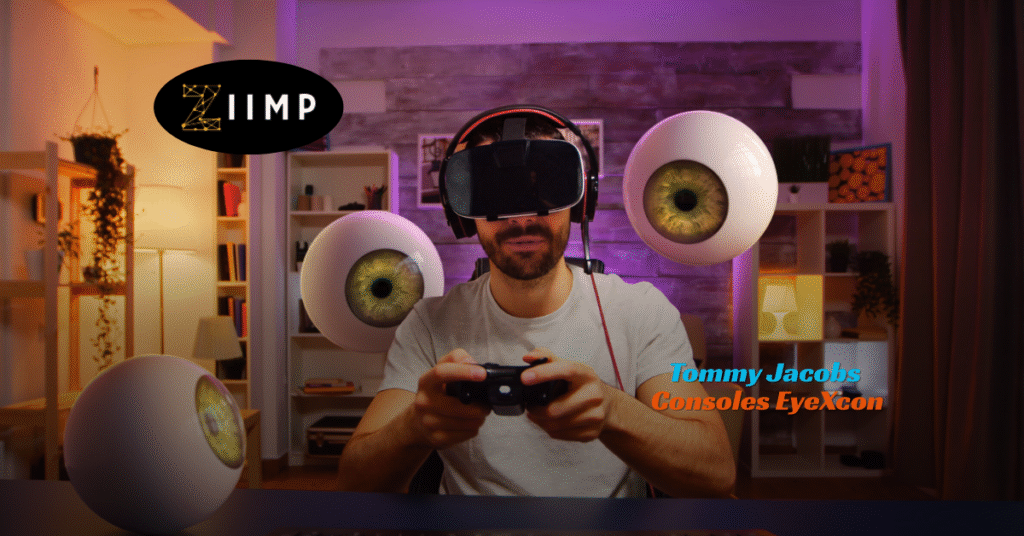
Gaming enthusiasts are always on the lookout for the next big innovation, and Tommy Jacobs Consoles EyeXcon: Full 2025 Feature Guide explores one of the most talked-about names in gaming technology. This article examines what EyeXcon promises in terms of eye-tracking, VR and AR support, adaptive AI, and immersive gaming experiences. We will break down the potential hardware specifications, how real-world performance might look, the impact on professional gamers and esports events, privacy and biometric tracking concerns, and whether this futuristic gaming platform lives up to the hype. By the end, you’ll have a clear view of EyeXcon’s possibilities and its place in the evolving gaming ecosystem.
Who Is Tommy Jacobs?
Since EyeXcon is speculative, there’s no verified public record of a “Tommy Jacobs” behind a major console project. In known VR and gaming hardware — from companies like Meta, Sony, or Valve — product names and creators link clearly to corporate entities, patents, press releases, and developer support. No such trace exists for “Tommy Jacobs Consoles EyeXcon.” That absence of credible background, corporate registration, or developer documentation raises a red flag. For any major console or hardware launch today, public traceability matters — making it unlikely that a legitimate “EyeXcon” project remains entirely under the radar.
What Is EyeXcon?
The concept tied to EyeXcon suggests a hybrid gaming console + VR/AR + biometric eye‑tracking + adaptive AI platform. It promises to merge many advanced features — eye‑tracking control, adaptive difficulty, mixed reality, biometric analytics — into a single gaming ecosystem. In theory, such a gaming platform aligns with where current VR/AR technology is headed: eye-tracking-capable headsets and adaptive rendering are already part of the real market. However, combining all these features at once in a polished, consumer-ready “console” would be a monumental engineering challenge. As of now, no public device matches that full scope. What exists are VR headsets with partial eye‑tracking or mixed reality support, but not a unified system with the full “EyeXcon-style” claim set.
Technical Specifications: Hardware and Performance
Modern VR and AR headsets with eye tracking deliver real benefits. For example, headsets like Meta Quest Pro and PlayStation VR2 incorporate eye‑tracking sensors to enable features like gaze-based UI and rendering optimization.
A realistic “next‑gen” gaming console with eye tracking might support high‑resolution rendering and adaptive frame rates by using techniques such as foveated rendering — where the system renders full detail only where the user is actually looking, and lowers resolution in peripheral areas. This method reduces GPU load while preserving visual quality.
However, achieving flawless 8K resolution, perfect eye‑tracking with 0.5° precision, reliable mixed‑reality overlays, “adaptive AI,” haptic feedback vest, and universal backward compatibility — all at once — would push beyond what mainstream hardware supports today. Real-world VR hardware is powerful, but balancing performance, comfort, latency, and quality remains a challenge.
Feature Deep Dive: What Makes EyeXcon Unique
Some features attributed to EyeXcon — like eye‑tracking, mixed reality support, adaptive rendering, and user‑tracking analytics — have real precedents. Eye-tracking in VR can improve user experience by enabling gaze-based controls, more natural UI interactions, and potentially more immersive gameplay.
Foveated rendering, enabled by eye tracking, is already used in certain VR headsets to reduce processing overhead by focusing high-resolution rendering where the user’s gaze is directed. This approach allows for smoother frame rates or longer battery life without degrading perceptible visual quality.
You may also like this: Gaming Updates pblinuxtech: Top 10 Must-Know Innovations
Eye tracking also opens possibilities beyond gaming: gaze-based user interfaces, attention analytics for training or educational tools, and more intuitive controls without traditional input devices.
However, features like full-body mixed reality with seamless AR overlay + VR immersion, biometric tracking for adaptive difficulty or user profiling, integrated haptic vests with spatial feedback, and universal backward compatibility across gaming platforms — remain speculative. No consumer hardware today publicly combines all those elements in a single product.
Real-World Performance: Testing and User Experience
In headsets that use eye tracking, research shows eye-tracking works with a reasonable level of accuracy. For instance, a study on a mixed reality headset found gaze-tracking accuracy around 0.9–1.1°, but also noted that accuracy alone doesn’t guarantee usability — comfort, calibration stability, and interface design matter a lot.
Users of existing VR devices often report that eye‑tracking improves UI navigation, social VR experiences, and rendering efficiency. Games or apps that support gaze‑based input can feel more intuitive and immersive.
At the same time, limitations remain: eye‑tracking can struggle in certain lighting conditions, with glasses or contact lenses, or when users move rapidly. Some users find calibration processes annoying.
Because of these real-world trade‑offs, even the best current VR headsets only deliver partial versions of the “ultimate” immersive gaming experience that EyeXcon claims.
Software & Ecosystem Impact
For any platform like EyeXcon to succeed, strong software and developer support are essential. Eye‑tracking and gaze‑based controls need software designed to use them — from UI navigation to gameplay mechanics. Existing VR systems with eye‑tracking still depend heavily on developers building gaze‑aware content.
In broader use cases — training, simulation, education — eye tracking can offer attention analytics and engagement insights. Studies show eye‑tracking is gaining interest not just for entertainment but for professional or training applications.
However, widespread adoption depends on standardization, privacy safeguards, and developer tools. Without those, many of the promised advantages remain theoretical.
Security, Privacy, and Data Protection
Tracking eye movements collects sensitive biometric data: gaze patterns, pupil dilation, and saccades. This data can reveal where you look, how long you focus, and even your emotional states. Such data poses serious privacy concerns.
Researchers have shown that eye-tracking data can identify individuals and even be used for continuous authentication.
Because of this, any real “EyeXcon”-style platform would need robust privacy protections: local data processing, encryption, anonymization, and opt-in controls. Current industry discussions emphasize the need for privacy‑by‑design in VR/AR eye‑tracking systems.
Without such protections, user gaze data could be sensitive — not just for gameplay, but for identity, behavior profiling, and more.
Common Misconceptions and Hype Debunked
It’s tempting to believe that because eye tracking is real and improving, a fully integrated “everything including the kitchen sink” console is just around the corner. But several misconceptions deserve caution. Eye tracking doesn’t automatically give perfect control: not all games support gaze-based input; many still rely on controllers. Eye-tracking performance varies depending on headset quality, calibration, lighting, and individual differences. What works in demo videos may not scale to everyday use.
The idea that eye tracking + adaptive AI + perfect rendering + seamless mixed reality + haptic feedback + full backward compatibility — all in one consumer-ready package — is highly unlikely today. Instead, real devices make tradeoffs: they emphasize a few strengths (like rendering efficiency, gaze‑based UI, social VR) without delivering the full Sci‑Fi vision.
You may also like this: Snapjotz com: Ultimate Guide to Organize, Capture & Share Notes
Potential Reasons for the Hype
Why do claims like EyeXcon surface? Partly because eye‑tracking and VR/AR are genuinely advancing. It’s easy to extrapolate current tech into grand visions. Also, the fascination with “next‑gen gaming” helps sell ideas. Some claims may originate from speculative design, wishful thinking, or marketing. Without concrete prototypes, it’s hard to separate ambition from demonstration.
In addition, content farms or sensational sites may reuse buzzwords — eye‑tracking, VR immersion, mixed reality, adaptive AI — to attract traffic, regardless of whether there is real hardware behind them. That amplifies hype beyond what’s technically achievable today.
Advice for Gamers: Is It Worth the Investment?
If you’re interested in cutting‑edge VR or eye‑tracking headsets, there are real, available products today. Headsets with eye tracking and gaze‑aware rendering can enhance experience — especially for social VR, immersive environments, or experimental games.
But approach “all‑in‑one console with biometric tracking and mixed‑reality” claims with caution. Always check for credible reviews, independent benchmarks, and privacy policies. Don’t trust unverified preorders or unsupported “feature lists.”
If you care about privacy, prefer devices and platforms that process gaze data locally, give you opt-in/out controls, and commit to secure data handling.
Future Outlook and Industry Implications
Eye tracking in VR/AR has real momentum. As headsets improve, with better optics, higher refresh rates, lighter design, more developers may embrace gaze-enabled inputs and rendering optimizations.
We may see a gradual shift instead of sudden leaps: incremental improvements in rendering, more social VR apps using gaze and facial tracking, industry standards for privacy and data protection, and better tools for developers.
Consumer‑ready immersive consoles combining multiple advanced features may remain a few years away — but parts of that vision are slowly becoming reality.
The Truth About Tommy Jacobs Consoles EyeXcon
The idea behind “EyeXcon” — a unified platform with eye‑tracking, mixed reality, adaptive AI, and immersive feedback — sounds compelling. But no publicly available hardware or credible developer roadmap supports such a device today. Real eye‑tracking VR headsets exist, and they validate several elements of the vision. Still, the full “all‑in‑one console” remains speculative.
Until there is independent evidence — prototypes, technical specs, reviews, developer documentation — readers should remain skeptical of sweeping claims.
You may also like this: Classroom 60x, 30x, 20x, 15x & 10x Series Comparing: Features, Benefits, and Differences
Frequently Asked Questions
What is Tommy Jacobs Consoles EyeXcon?
EyeXcon is said to be a gaming console that mixes VR, AR, and eye-tracking to give a more interactive gaming experience. Its full features aren’t verified yet.
Can EyeXcon track my eyes during gameplay?
In theory, it would use eye-tracking to see where you look and adjust the game, but no verified device currently offers the complete package claimed.
Does EyeXcon support VR and AR games?
The concept suggests both VR immersion and AR overlays. Real-world headsets do VR and some AR, but EyeXcon, as described, is not confirmed.
Is biometric tracking safe for privacy?
Eye tracking collects sensitive data like gaze patterns and pupil reactions. Any real system should process data securely, give opt-in options, and protect your privacy.
Can beginners use EyeXcon easily?
If implemented well, eye-tracking and adaptive systems could help beginners by adjusting difficulty and guiding gameplay. Real products with these features exist, but EyeXcon itself isn’t verified.
Will EyeXcon improve competitive gaming?
Eye tracking can help with attention management and peripheral awareness, which may aid training. Real-world competitive gaming uses some of these tools, but the full console isn’t confirmed.
Does EyeXcon work with old games?
Backward compatibility is claimed, but there’s no evidence that a console can run thousands of legacy titles with enhanced features today.
Do you need special VR headsets or AR glasses?
Conceptually, yes — VR headsets and AR glasses would be needed to use the full features, similar to existing hardware like Meta Quest or PlayStation VR.
How fast is the console supposed to be?
Claims include high-resolution 8K processing and real-time adaptation. Real high-end gaming PCs and headsets can achieve parts of this, but no consumer console currently matches the full specs.
Is it worth buying EyeXcon now?
Since there’s no verified device yet, it’s better to explore real VR and eye-tracking headsets for immersive gaming rather than pre-order or trust unverified claims.
Conclusion
Today’s gaming and VR technology is evolving. Eye tracking is real, offering tangible benefits for rendering optimization, gaze‑based controls, immersive social interactions, and more. At the same time, claims of a “console that does everything” — from biometric adaptive AI to mixed‑reality overlays and haptic feedback vests — remain mostly aspirational.
For gamers, the key is to stay informed. Real devices with modest but real benefits exist now. When evaluating future “next‑gen” consoles or platforms, look for evidence: real hardware, developer support, independent reviews, and transparent privacy practices. Until then, treat bold claims with curiosity — not as fact.
Author Profile

- I am the editor and publisher at Ziimp.net. I write clear and helpful content about credit cards, markets, technology, and trading. My focus is on simplifying finance and using smart tools to help readers make better decisions. I also explore new ideas to improve the platform and create a better experience for users.
Latest Posts
 FinanceDecember 13, 2025Indexationnews com Explained: Honest Guide to Finance & Loans
 FinanceDecember 13, 2025AnalyzingMarket com Explained: Honest Insights & Reviews
 TechnologyDecember 12, 2025SSIS 469 Error Explained: Ultimate Causes, Fixes, and Prevention
 ReviewDecember 12, 2025Techmapz com Guide 2025: Full Comprehensive Platform Overview